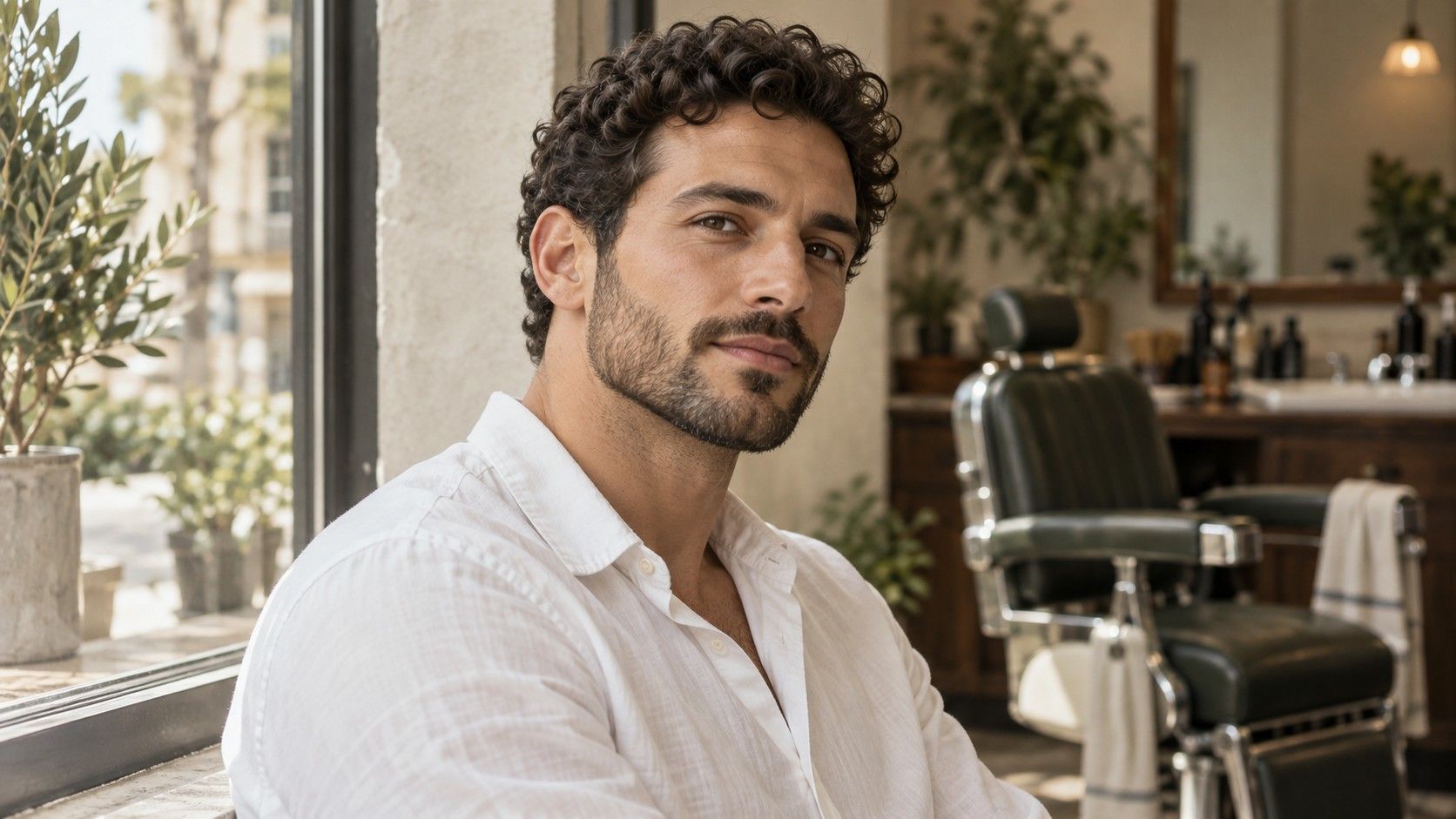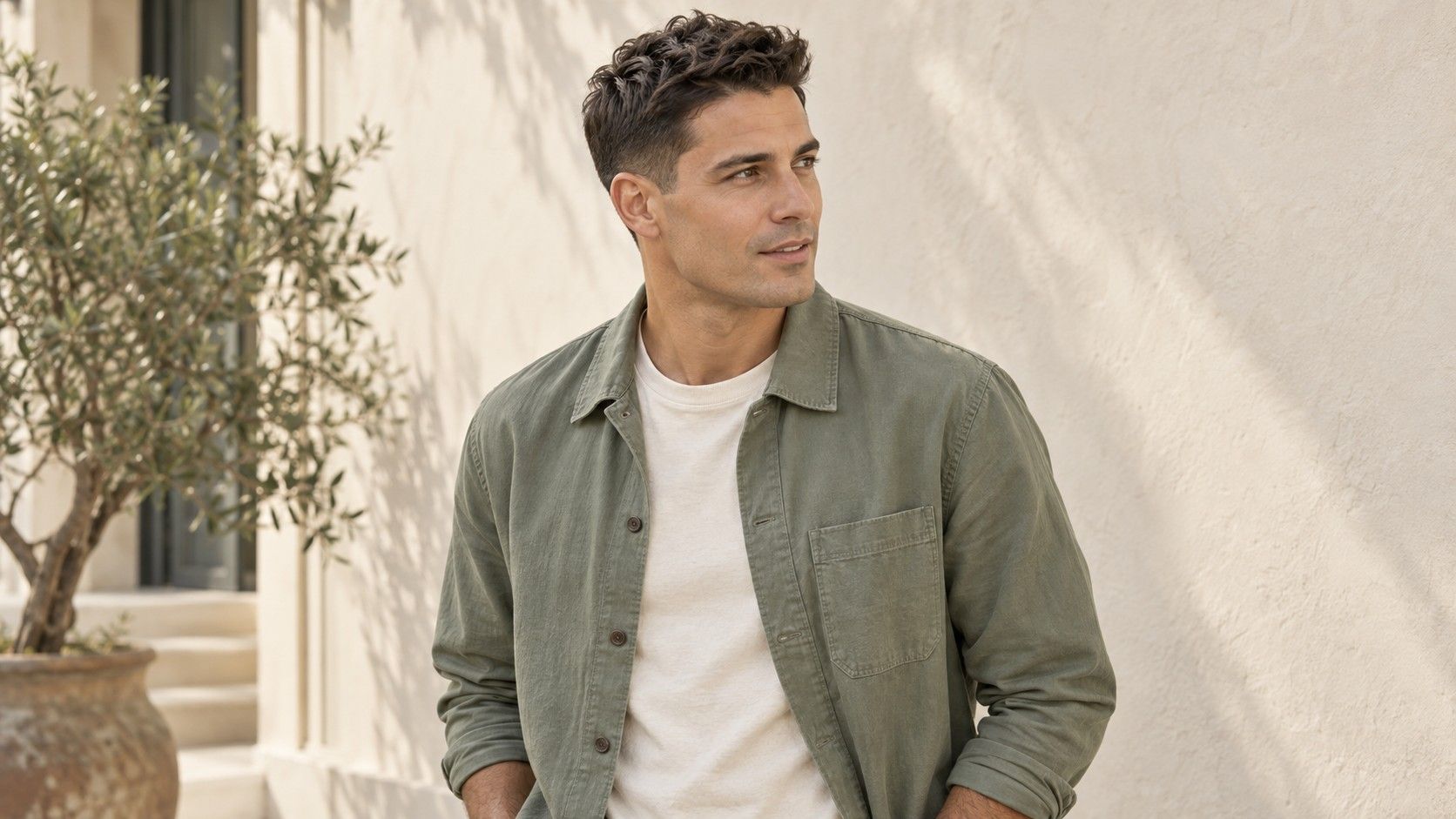
An oval outline leaves room to try many haircut shapes, but it does not choose the top, sides or fringe for you. Those details depend on your hair, the look you enjoy and the work you will put into it. Use the barber visit to settle those decisions in practical terms before committing to a familiar haircut name.
Decide whether to show the forehead
Before choosing a haircut name, decide what you want to happen at the front. Hair swept up or back leaves more forehead visible. A crop or fringe covers part of it. Both are options for an oval face, and the choice can be about personal style rather than changing your proportions. Try pushing your existing front hair in both directions and look at the whole outline.
The hairline and growth direction will affect how easily either version holds. A front section that naturally splits may need daily attention to form a solid fringe. Hair swept away from the forehead may need length, drying or product to stay there. Show the barber how it falls before it is wetted or styled so the plan starts from your actual growth pattern.
Think about ordinary situations as well as the mirror at home. A fringe can touch the lenses of glasses or move when you put on a cap; a raised front may need resetting after the cap comes off. Choose the inconvenience you are willing to handle. A photograph that looks good for a few seconds does not tell you which option fits your morning.
Compare crop and side part shapes
A textured crop generally places attention on a shorter, forward-directed top, while a side part organizes the hair across or away from the forehead. Those descriptions leave plenty of variation. A crop can have a soft irregular fringe or a sharper edge; a side part can lie close to the head or carry visible height. Look beyond the haircut label to those details.
Compare references with a similar hair texture and enough detail to see the sides. A straight, dense crop may not behave like the same outline on loose curls. A crisp side part in a photograph may depend on a deliberate blow-dry and a defined finish. Ask the barber to identify what your hair can do with your usual routine and where the reference will need adapting.
You can borrow an element without copying the complete cut. Perhaps you like the forward fringe of one image and the softer side length of another. Explain that combination and let the barber discuss the transition between them. When considering oval face hairstyles for men, the most useful comparison is often the amount of forehead, width and height each version shows.
Choose side length with care
A very close side can create a strong difference between the top and the area above the ears. Retaining more length there makes a softer outline and may leave more visible width. Neither is required for an oval face. Use the mirror to decide whether you like the emphasis on the top, then check the profile and back rather than judging the cut from the front alone.
Fade and taper labels are starting points, not complete instructions. Ask where the shortest area will begin, how high the transition will travel and whether the skin will show. A reference photograph helps clarify what “low” means to you. If you want to keep fullness around the temples, say that directly before the clippers remove it.
Also discuss the growing-out stage. A sharply defined short side and a longer scissor-cut side can change appearance in different ways between appointments. Tell the barber how often you realistically return. If the first signs of growth bother you, include that in the decision instead of choosing a cut on the assumption that every day will resemble the day it was finished.
Control height through the top
Height through the front or crown can make the hairstyle look more elongated. You may like that effect, or prefer a flatter top that keeps the outline quieter. Use a side view to check how much height the reference actually has. From the front, lighting and dark hair can hide a raised section that becomes obvious in profile.
Ask which part of the height comes from the cut and which part comes from styling. A longer front can be arranged upward, but the finished shape may rely on drying it into position. Shorter hair may stand up in a way that cannot be combed flat until it grows. The barber needs to know whether you want a styled finish or something close to your natural resting shape.
Be specific about tools and time. “I use a dryer and can spend a few minutes on the front” gives different instructions from “I towel-dry and leave.” Product finish matters as well: a shiny, defined shape and a loose matte texture can make similar lengths look quite different. Try the proposed amount while you are there and ask how to distribute it through your hair.
Coordinate the haircut with facial hair
The haircut and beard form one visible outline around the face. Longer hair below the chin can extend that outline; fuller growth along the jaw can change its apparent width. These are optional effects to consider, not reasons to grow a beard or remove one. Look at the combined shape you actually wear before making separate choices from unrelated photographs.
Pay attention to the sideburn connection. A close fade, a longer sideburn and a disconnected beard each create a different transition near the ear. Show where you want the join to sit and ask how it will look as both areas grow. If you visit different people for hair and beard trims, keep a photograph of the arrangement you liked so the next appointment has a clear reference.
If you prefer a clean shave, build the haircut around that everyday appearance. Do not judge a reference solely by its face outline if a full beard contributes much of the lower shape. Equally, there is no need to trim a comfortable beard to fit an oval-face recommendation. Explain the feature you want to keep and adjust the surrounding hair accordingly.
Give the barber a workable plan
Arrive with a small number of clear references and identify the part you like in each. Include a picture you dislike if it helps show a boundary, such as sides taken too high or a fringe cut too bluntly. Keep your own hair close to its normal state where possible so the barber can see the part, crown and front growth before deciding on the shape.
Give practical limits in plain language: enough length to push the front back, no exposed skin at the temples, a fringe that clears the glasses, or a cut that needs little drying. If the haircut name and those limits conflict, ask about the limits first. Clipper numbers alone cannot explain the height of a transition or how the top should connect to it.
Before leaving, look at the front, profile and back and ask for the routine to be demonstrated. Note what you would keep for the next visit and what needs more length or less height. Choosing men’s haircuts for oval faces is easier when the appointment produces a repeatable plan: where the hair falls, how short the sides feel and what you can comfortably maintain between cuts.
Check the front when it is left alone as well as when it is arranged deliberately. If the fringe springs up or divides as soon as you release it, that behavior belongs in the plan. A reference can still be useful, but ask what daily steps would bridge the difference between your natural fall and the photograph.
Consider the setting where you wear the haircut most often. A neat side part may fit your preferred clothes, while a looser crop may feel easier after cycling or taking off a helmet. There is no need to assign either look to a face category. Pick the silhouette you enjoy and ask how its shape can recover after the interruptions in your ordinary day.